Then & Now
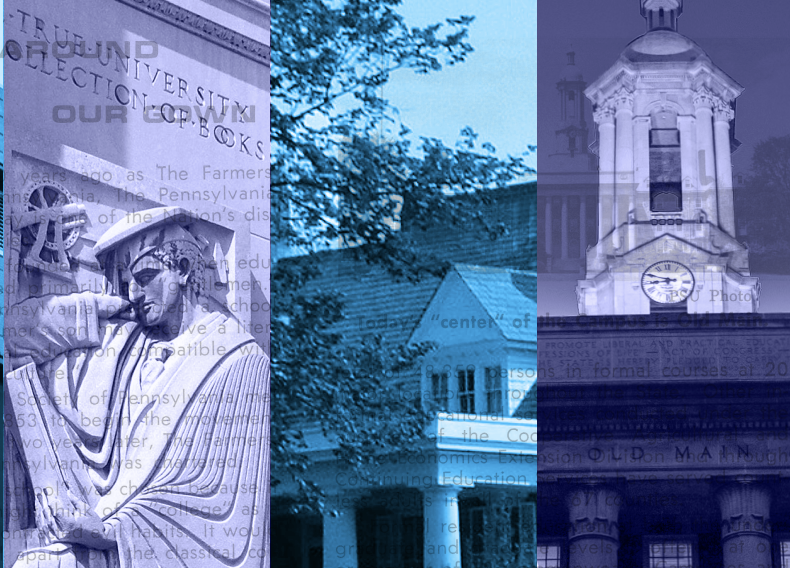
Each month during Town&Gown’s 60th-anniversary year, we’re updating an article from our early issues. First up: a February 1966 article about the history of Penn State.
When Town&Gown magazine was founded in 1966, Penn State had just celebrated its 110th birthday. In-state tuition was $450 per year, and approximately 22,000 students were enrolled at University Park. Entire dorm floors shared one phone line and one community bathroom. Students were beginning to engage in on-campus demonstrations such as the March 1966 “Heel and Hose” protest opposing a university rule that prohibited women students from visiting men living in off-campus apartments. Eric Walker was in his 10th year as Penn State’s president, and Joe Paterno was starting his first season as head coach of the football team.
The six decades that followed took the university through periods of prosperity, times of turmoil, and changes that would make some aspects of campus and campus life almost unrecognizable to a time traveler from 1966.
Academic Life
Today, enrollment at University Park is about 48,000, and tuition is over $20,000 for in-state residents. Penn State’s undergraduate colleges have expanded from 11 in 1966 to 13. Some colleges, like Home Economics, have been dropped, while new ones have been added, including the College of Information Sciences and Technology (1999), the Donald P. Bellisario College of Communications (established in 1985, named for Bellisario in 2017 after his $30 million gift), and the Ross and Carol Nese College of Nursing (established in 1989, named in 2021 after a $27 million gift). Others have been renamed: the Division of Counseling is now the Division of Undergraduate Studies; the Smeal College of Business and the Eberly College of Science were named after donors; and Health and Physical Education became the College of Health and Human Development.
The Penn State College of Medicine in Hershey welcomed its first students in 1967, and the Milton S. Hershey Medical Center opened in 1970. In 1997, Dickinson School of Law in Carlisle merged with Penn State, and by 2009, University Park had established its own law school with the opening of the Lewis Katz Building.
In 1966, there were 18 commonwealth campuses across Pennsylvania, with Penn State Brandywine becoming Penn State’s 19th campus in 1967. Nineteen campuses remain today, but seven campuses are slated to close in 2027, following a decision by the Board of Trustees citing “enrollment and financial decline … and significant maintenance backlog.”
The 1990s introduced the world and the university to the World Wide Web, affecting virtually every aspect of campus life. In 1998, Penn State offered its first online course — turfgrass management — and the Penn State World Campus was born. Today, World Campus offers over 175 undergraduate and graduate degrees and serves over 20,000 students each year.
Campus Expansion
The 1970s saw a building boom on campus with the addition of the Milton S. Eisenhower Auditorium, the Liberal Arts Tower, the Agricultural Administration Building, the Museum of Art, and major additions to the HUB.
Some notable buildings added since then include Thomas Building (1992); the Paterno Library addition to Pattee Library (1994); Pasquerilla Spiritual Center — the largest multifaith center of its kind in the United States (2003); Business Building (2005); and Millennium Science Complex (2011).
In 2004, the Information Sciences and Technology Building, now Westgate Building, was built, its signature 800-foot walkway extending across North Atherton Street to west campus, which is home to the Earth and Engineering Sciences Building and two additional engineering buildings.
In 2006, a new Food Science Building (later named the Rodney A. Erickson Building) was completed and became the new home of the Penn State Berkey Creamery.
The Arboretum at Penn State opened to the public in 2009, serving as an anchor to the university’s new Cultural District, which includes the new Palmer Museum of Art (2024) and future plans for a STEM museum, performance space, planetarium, and conservatory.
The Susan Welch Liberal Arts Building opened in January 2025; in November, it was temporarily closed following a structural damage issue. The Nursing Sciences Building was recently renovated and expanded, and Sackett Building and Osmond Lab are undergoing major renovations. Oswald Tower was demolished in 2025, with Hammond Building next on the docket for demolition. A new classroom building is slated to open along Park Avenue by fall of 2026.
Improved Living Space
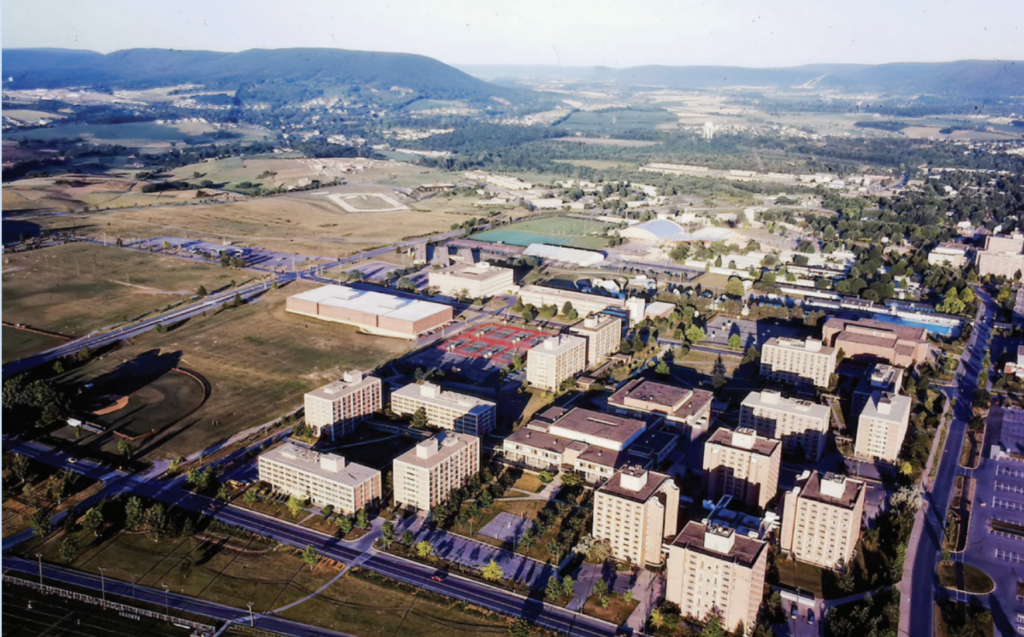
In 1966, East Halls was a new housing complex on what was then considered the far reaches of campus. It joined the other dormitory complexes of West, North, South, and Pollock halls, all of which have since either undergone or are slated to begin major renovations. The renovations add modern amenities such as climate-controlled rooms and semi-private bathrooms.
Nittany Apartments opened on campus in the mid-1980s, and in 2004, Eastview Terrace opened — a residence hall complex providing upper-class students with single rooms and private baths.
Off campus, luxury student apartment living has become the norm, with new high rises like Rise, Maxxen, and the Metropolitan popping up throughout the downtown area and including amenities like state-of-the-art fitness centers, rooftop swimming pools, and game lounges.
Sports Facilities
Sports facilities fall into their own category of on-campus building projects. In recent decades, the “stadium district” has blossomed on the east side of campus, beginning with the Bryce Jordan Center, which tipped off in 1996 as the new home of men’s and women’s basketball and a concert venue.
In 2006, Medlar Field at Lubrano Park opened, home of Penn State baseball and the State College Spikes, and in 2011, Nittany Lion Softball Park opened.
In 2013, the first puck dropped at Pegula Ice Arena after an $88 million donation from Terry and Kim Pegula, allowing for the university hockey teams, formerly club sports, to become NCAA Division I teams.
Panzer Stadium, home of the Penn State lacrosse teams, was completed in 2019, and in 2024 the Field Hockey Complex (established in 2005) was renovated and upgraded.
A new operations center for the soccer teams is currently under construction at Jeffrey Field, and a new multi-sport indoor practice “bubble” was added beside it this fall.
Sports History Highlights
Aside from the facilities, the history of Penn State sports teams over the past 60 years could fill several books. These are just a few of the major developments and accomplishments in the athletic department:
In 1966, Joe Paterno won his first game as head coach of Penn State football, defeating the University of Maryland by a score of 15-7 in front of a Beaver Stadium crowd of 40,911. He would go on to win 408 more, making him the winningest coach in college football.
With Title IX still six years away from passage, Penn State’s women’s field hockey team participated in intercollegiate competition. Several other women’s varsity sports teams—including golf, lacrosse, basketball, riflery, tennis, and softball — had difficulty finding other women’s collegiate teams to play against, so participation was often at an intramural level.
Today, Penn State has 13 intercollegiate women’s sports, 14 men’s sports, and one co-ed sport (fencing).
It is worth noting that the Penn State Blue Band was an all-male marching band until 1973. In 2025, Ellie Sheehan became the Blue Band’s first female drum major.
Penn State joined the Big 10 conference in 1990, which not only shifted the athletic landscape from a competition perspective but also had a positive impact on funding for all university sports teams. Penn State sports teams have won 131 Big 10 championships since joining the conference.
In 2009, Penn State hired Cael Sanderson as its new head wrestling coach, and a dynasty was born. Sanderson has coached the team to 12 NCAA national championships and has coached 36 individual champions as well. Fencing is the only Penn State sport to have achieved more NCAA championships since 1966, with 13.
Darker Days
Unfortunately, Penn State’s recent history includes some turbulent periods that must be acknowledged. In 2011, former Penn State football defensive coordinator Jerry Sandusky was arrested for sexual assault of minors, many of whom he met through the nonprofit he established, The Second Mile, and some of whom he brought onto Penn State’s campus. He was eventually convicted and sentenced to 30-60 years in prison.
Repercussions reverberated through the community. Head Coach Joe Paterno was abruptly fired, and the football team was heavily sanctioned by the NCAA, including a $60 million fine, a four-year postseason ban, the loss of 40 scholarships, and the vacating of all of the football team’s victories that occurred from 1998 to 2011 (these were reinstated in 2015). Athletic Director Tim Curley and President Graham Spanier also were fired, and eventually they and retired Vice President Gary Schultz served jail terms for misdemeanor charges.
In 2017, another scandal rocked the university when freshman Timothy Piazza died following a hazing incident at Beta Theta Pi fraternity, a tragedy that led to one of the largest hazing prosecutions in American history. Beta Theta Pi was permanently shuttered, and the Piazza family advocated for anti-hazing laws that were eventually passed in several states.
Finally, like the rest of the world, Penn State experienced the difficulties of COVID-19 when the pandemic hit in March 2020. Much of campus shut down and the university pivoted to mostly online instruction through spring of 2021. Entire sports seasons and other university-sponsored programs were canceled. At least two University Park students died from complications of the virus during this time.
Penn State Presidential History
In 1966, Eric Walker still resided in University House on campus, but in 1970 the Board of Trustees relocated the president’s house to Kennard Road in Boalsburg, citing safety and privacy concerns. University House is now part of the Hintz Family Alumni Center.
In 1995, the president’s residence moved to Schreyer House, located on the north side of Park Avenue adjacent to the Arboretum.
In 2022, Neeli Bendapudi made history as the first woman and first person of color to serve as president of Penn State.
Penn State presidents since 1966:
- Eric A. Walker (1956-1970)
- John W. Oswald (1970-1983)
- Bryce Jordan (1983-1990)
- Joab Thomas (1990-1995)
- Graham Spanier (1995-2011)
- Rodney Erickson (2011-2014)
- Eric J. Barron (2014-2022)
- Neeli Bendapudi (2022-present)
Beaver Stadium History
- 1966: Capacity of Beaver Stadium is 46,284.
- 1969-1980: Stadium expansions take capacity to 83,770
- 1984: Lights are added to the stadium, allowing for night games.
- 1991: Upper deck is added to the north end zone, bringing an additional 10,033 seats.
- 2001: An 11,500-seat upper deck is added to the south end zone, and 60 enclosed skyboxes are added above the east stands, increasing the stadium’s overall capacity to 106,562.
- 2002: The All-Sports Museum opens inside the south end of the stadium.
- 2017: The first concert is held inside Beaver Stadium (Happy Valley Jam featuring Blake Shelton).
- 2024: Beaver Stadium kicks off a $700 million revitalization project to include luxury suites, loge boxes, and climate-controlled club sections on the west side. It is expected to be completed in 2027.
- 2025: Beaver Stadium is renamed West Shore Home Field at Beaver Stadium after a $50 million gift from West Shore Home and CEO B.J. Werzyn.
- 2026: Beaver Stadium hosts its first ice hockey games on Jan. 31, when the Penn State men’s team faces Michigan State and the Penn State women’s team faces Robert Morris.
History of THON
Although it did not even exist it 1966, THON has grown to become the largest student-run philanthropy in the world, and a great source of pride for Penn Staters.
- 1973: The first Penn State Dance Marathon takes place in Penn State’s HUB ballroom, raising $2,000 for The Arc of Butler County.
- 1977: The Four Diamonds Fund at the Milton S. Hershey Medical Center — supporting pediatric cancer patients and research — becomes the event’s beneficiary, a partnership that continues to this day.
- 1979: Having outgrown the HUB ballroom, the IFC Dance Marathon relocates to White Building.
- 1987: The name of the event officially becomes THON.
- 1999: THON moves to Rec Hall.
- 2007: THON relocates once more to the Bryce Jordan Center.
- 2025: THON raises $17,737,040.
Penn State National Championships Since 1966
- Football: 1982, 1986
- Men’s Gymnastics: 1976, 2000, 2004, 2007
- Women’s Gymnastics: 1978, 1980
- Women’s Lacrosse: 1978, 1979, 1980, 1987,1989
- Women’s Soccer: 2015
- Men’s Volleyball: 1994, 2008
- Women’s Volleyball: 1999, 2007, 2008, 2009, 2010, 2013, 2014, 2024
- Wrestling: 2011, 2012, 2013, 2014, 2016, 2017, 2018, 2019, 2022, 2023, 2024, 2025
- Fencing: 1990, 1991, 1995, 1996, 1997, 1998, 1999, 2000, 2002, 2007, 2009, 2010, 2014
The Next 60 Years
As the saying goes, “change is the only constant.” While every department at Penn State has a long-term plan for future growth, national and global events can always shift those plans. Whatever challenges the next 60 years bring, it’s a good bet that landmarks such as the Nittany Lion shrine, Old Main, and the Obelisk will remain as steady reminders of the university’s rich and continuing history. T&G
Karen Walker is a freelance writer in State College.